Corrugated cardboard for packaging: types and grades
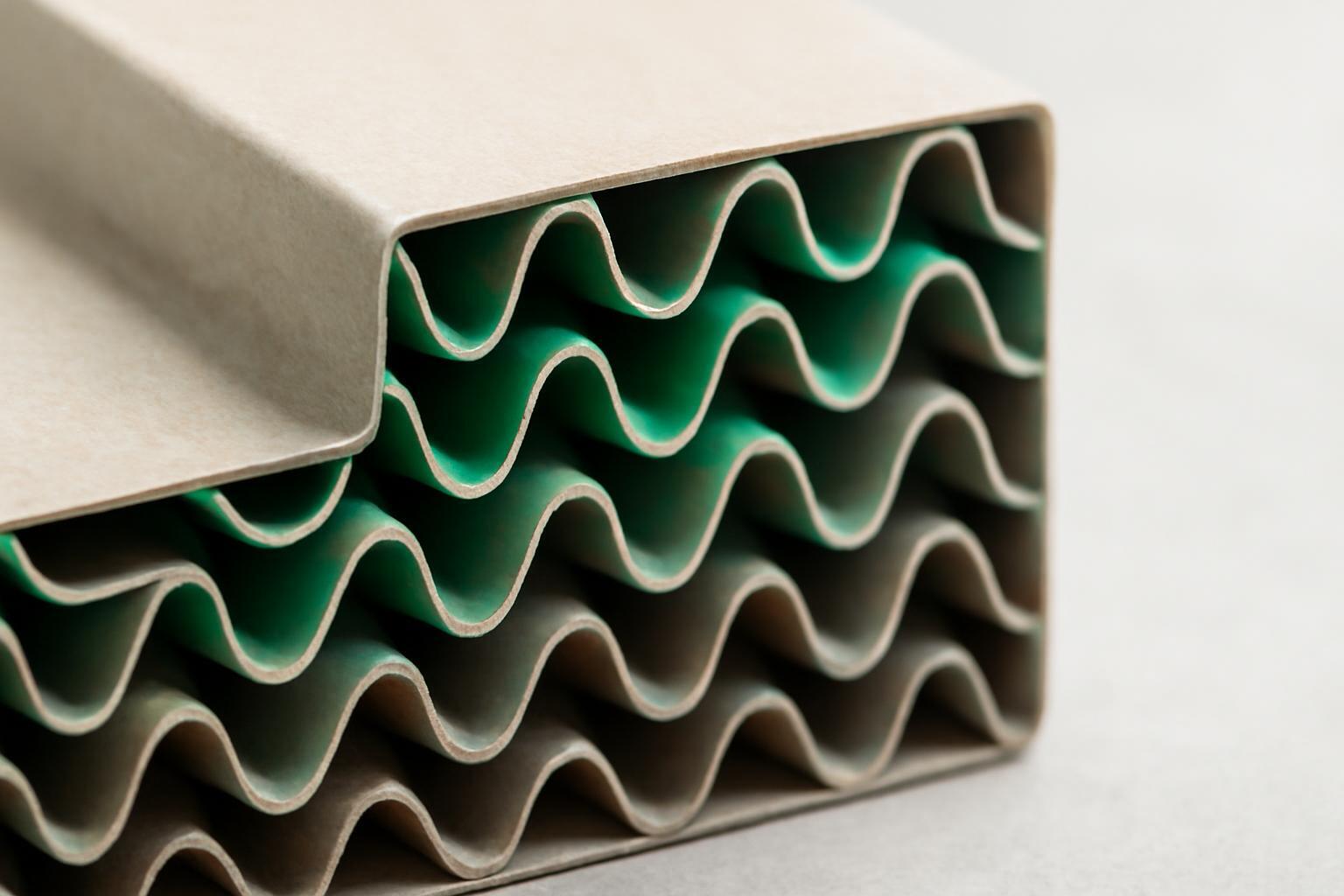
What corrugated cardboard grade is actually made of
Corrugated cardboard is classified by two independent parameters: the number of layers (type) and the quality of raw materials, which is reflected in the grade number. The type is denoted by letters D, T, P, S — from two-layer packaging to seven-layer, capable of replacing wooden battens. Within each type, grades differ by the composition of cellulose and wastepaper: the higher the second digit in the grade designation, the higher the quality and cost of raw materials, and therefore the higher the tensile and compression strength at the same thickness.
It is precisely this relationship — quality of raw materials vs. price — that is most often overlooked when choosing. Two sheets of cardboard of the same thickness can hold completely different weights if one is made from a mixture of cellulose and wastepaper, and the other — almost entirely from cellulose.
T-series grades: how T-21 differs from T-24
Three-layer corrugated cardboard (T) — the most mass-market type for packaging: boxes for e-shops, footwear, household appliances of medium weight. The difference between popular brands is not in thickness, but in maximum load capacity and price per square meter.
| Brand | Maximum cargo weight | Price from, rub/m² (2026) | Typical application |
|---|---|---|---|
| T-21 | 10–15 kg | 26,4 | light goods, clothing, cosmetics |
| T-22 | 13–15 kg | 29,8 | footwear, lightweight dishes |
| T-23 | 15–18 kg | 32 | household appliances, books |
| T-24 | up to 20 kg | 35,1 | tools, heavy electronics |
The price difference between T-21 and T-24 is around 33%, but it is precisely these rubles per square meter that become decisive when ordering 10 000 boxes. Taking T-24 'just in case' for a product weighing 3 kg is money wasted on strength that will never be needed.
Wave profile: what actually affects durability and printing
In addition to the brand, the characteristics of the box are also influenced by the height of the corrugated wave — it determines the cushioning, stiffness, and the ability to apply high-quality printing to the cardboard.
- Profile A (4,4–5,5 mm) — best shock and vibration cushioning, but the large wave does not allow for clear printing: suitable for transport packaging without branding directly on the corrugated surface.
- Profile B (2,2–3,2 mm) — dense structure, holds shape well during die-cutting, a compromise between strength and printability.
- Profile C (3,2–4,4 mm) — a balance between A and B, the most universal option for standard boxes.
- Profile E (1,1–1,6 mm) — micro-wave, ideal for direct flexographic printing and small products where package presentation is important.
If a brand wants to print a logo directly onto the corrugated box with clear lines and small text — profile A is physically excluded; here, profile E or a combined CE is needed.
Five-layer and seven-layer cardboard: when three layers are not enough
The P-series (five-layer) starts at 45,9 rubles/m² for P-31 — this is almost 30% more expensive than the top-tier three-layer T-24. The extra cost is justified only where the load actually exceeds 20 kg: P-32 and P-33 are designed for significantly higher loads (30-50 kg and above), depending on the box construction and dimensions. For an online clothing or cosmetics store, five-layer cardboard is just money down the drain; the three-layer T-22–T-23 fully covers the task.
Seven-layer cardboard is a separate story: it can withstand loads in the range of 200–1000 kg, depending on the brand, and is 2–3 times more expensive than three-layer cardboard. It is not used for "packaging," but for industrial packaging as a replacement for wooden crates — large household appliances, machinery, furniture in disassembled form.
In five- and seven-layer cardboard, combined wave profiles are often used: BC provides a balance of stiffness and compressive strength, while CE provides a smooth surface for printing while maintaining load-bearing capacity. If the box is both transport packaging and a shelf-display advertising medium, the combined CE profile addresses both tasks, whereas the pure A profile is not suitable for printing at all.
Microflute cardboard: an underrated alternative
Marks T-11, T-12, T-13 belong to the first class — with high cellulose content, unlike the second class (T-21–T-27) with a mixed composition. The thickness of such cardboard is only 1,5–1,8 mm, but in terms of strength it often exceeds ordinary three-layer cardboard precisely due to the quality of raw materials, not the number of layers. This makes microgofrocardboard a good choice for premium packaging — boxes for perfumery, electronics, gift sets, where compactness and an attractive appearance are important, rather than impact resistance during transportation in a truck bed.
How to choose a mark for a specific product
| Industry/Product | Recommended mark | Profile | Comment |
|---|---|---|---|
| Fragile dishes, glass | T-23–T-24 or P-32 | A or BC | impact absorption is needed, not rigidity |
| Food products | T-21–T-22 (food cardboard) | C | sanitary safety of raw materials is important |
| Electronics, gadgets | T-11–T-13 (microgofra) | E or CE | compactness + quality printing |
| Furniture, large appliances | P-33 or seven-layer | VS | weight over 25 kg |
| Clothing, cosmetics, light e-commerce | T-21 | V or S | minimum price with sufficient strength |
The mistake that people most often make is choosing a brand "by habit" or "like everyone else", without calculating the actual weight and without considering whether printing directly on the box is needed. The difference of 5–10 rubles per square meter between adjacent brands on a batch of tens of thousands of packages turns into hundreds of thousands of rubles—and this is exactly where packaging branding should start with an engineering calculation, not aesthetics.
Recent articles





MegaFon, BMW, VTB and more 240+ companies. See how it looks in the showcase reel:


Our branding agency is approached to order:
Branding agency services












