Site on Tilda for a brand: design, layout, cost
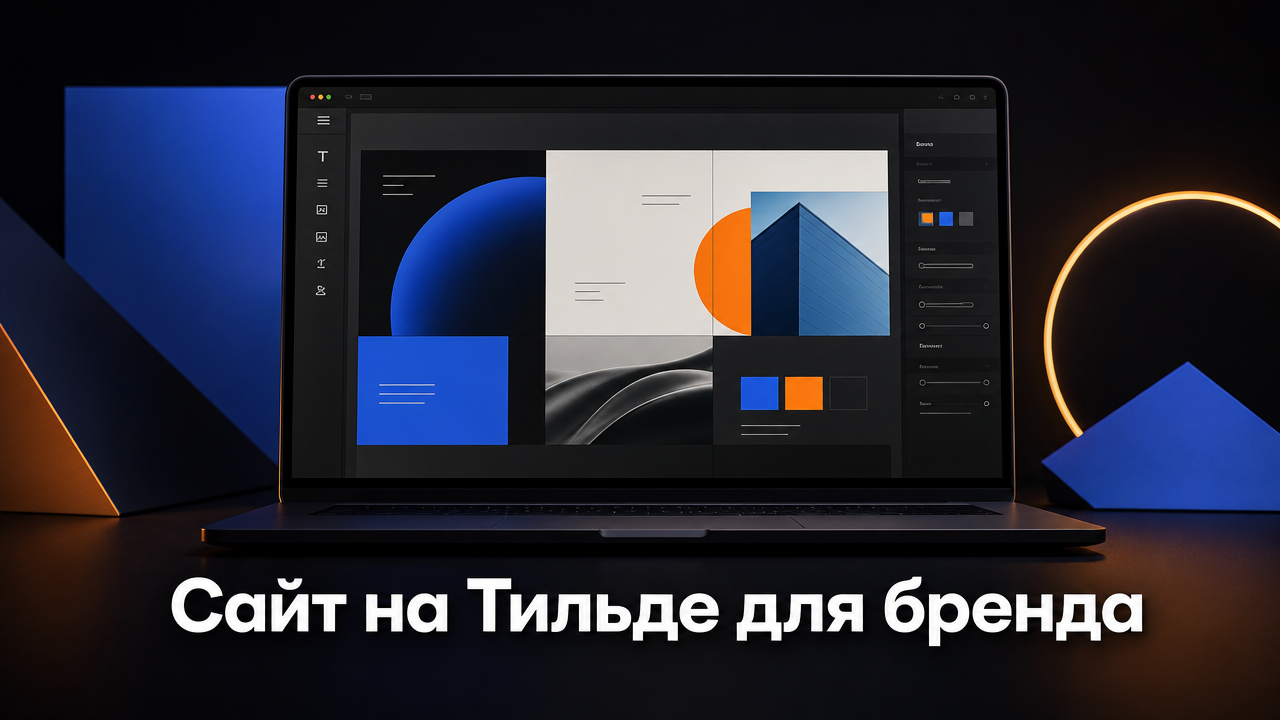
Tilda has long ceased to be a builder exclusively for landing pages. Sites are made for major brands — with unique design, complex animation, and sufficient performance for a commercial project. If you need a site no worse than custom development, but with a shorter launch cycle, Tilda is a viable option. Let's explore what you can actually build on it, what determines the cost, and why you should trust the team that is already engaged in branding, not just layout.
What is a brand site on Tilda
Many still think that Tilda is a set of ready-made templates that all look alike. In reality, the platform provides the Zero Block tool: with it, a layout is assembled from scratch — arbitrary margins, layers, animation, and custom elements are set. The site becomes as individual as with development from scratch, but noticeably faster. For a brand, this means the site can fully replicate the brand style: the same fonts, colors, modular grid, patterns. Tilda also implements more complex things — design systems with a set of repeating components (buttons, cards, forms) that maintain a consistent style across all pages. This is especially important if a company already has a brand book: then the site does not 'disagree' with other media, but continues their logic. Zero Block allows not just inserting ready-made blocks, but constructing each section separately: changing the layout of elements, layering, adding custom CSS for fine-tuning. This enables non-standard solutions — dynamic grids, unusual card forms, parallax effects, which usually require programming. At the same time, all functionality remains within the platform — this simplifies support and future edits.
Design system on Tilda: how the brand looks in digital
A design system for a website is not merely a set of colors and fonts in and of itself. It is a modular grid, typography, components (header, footer, product cards, forms) and rules for their usage. When a website is built on such a system, it looks cohesive, scales easily, and does not require reworking with each new section. Gromov Branding begins design system development for Tilda websites with an analysis of the client's brand book. Next, the design system itself is planned: margins, heading sizes, buttons, styles for illustrations and photographs. All of this is recorded in Tilda's block library — so when adding new pages, it is not necessary to reinvent the layout each time. This approach provides several practical advantages: A unified visual language — the user recognizes the brand on any page without additional cues. Fast development — new sections are assembled from ready-made components in hours, not days. Easy updates — if a button color is changed in one place, it changes across the entire website. The design system also simplifies handing over the project to support: a new designer or developer can understand the structure without extensive immersion. For the business, this means that the website does not 'freeze' after launch — it can be refined, new sections added, and accents changed without compromising quality (though only if the system was initially designed with growth in mind, not assembled on a residual basis).
Layout and functionality: what can be done on Tilda
Zero Block offers a fairly wide range of customization options. On Tilda, the following are implemented: animation of elements on scroll, parallax, micro-interactions; adaptive layout for mobile devices with separate settings for tablets and phones; integrations with CRM (e.g., amoCRM or Bitrix24); subscription forms, online payment via YooKassa or Robokassa; custom calculators, timers, sliders; multilingualism and SEO settings — meta tags, Open Graph, microdata. In the Gromov Branding portfolio, there are Tilda websites for various businesses: from a catering company and a center for phyto-cosmetics to a network of dental clinics and an IT product. Each project was built for a specific task, not adapted to a template. Let's take the website of a catering company. The task was to display the menu, photos of dishes, an order form, and contacts in such a way that visitors would not get lost in the sections. Designers created a modular grid where each food category expands into a separate block with an animation on appearance, and integrated the order form with CRM — requests go directly to managers without manual transfer. The adaptive layout preserved readability on phones, as that is where the main order flow comes from. Another example is the website of a phyto-cosmetics center, where the key task was trust: photos of procedures, testimonials, certificates. Here, parallax effects were used for smooth transitions between sections and online booking via a calendar was added. All of this is done on Tilda without a single line of external code — only using Zero Block's tools.
Cost of website development on Tilda
The price is composed of several factors. The number of pages and sections. A one-screen landing page costs less than a multi-page website with a catalog and blog. Design complexity. Unique animation, custom illustrations, and non-standard grids increase development time. Integrations. Connecting CRM, payment systems, and external services requires separate setup and testing. Content. Texts, image selection, and video — all of this also affects the budget and timelines. The exact figure will only be provided by the contractor after the briefing — there are no universal prices here, as there are too many variables. However, based on market experience, a website on Tilda usually costs less than a custom development on a CMS or framework, and the timelines are shorter: from 2 to 4 weeks versus 2–3 months for classic development. The key condition is that the agency quotes the cost before the start and does not change it during the project. In Gromov Branding this is formalized as the principle of "Everything is clear before the start": the client receives a detailed estimate broken down by stages — strategy, design, layout, integrations, testing. Any changes are documented separately, so the final amount does not become a surprise at the finish.
Why you should order a website on Tilda from a branding agency
When a website is ordered separately from the branding, a gap often occurs: it looks different from business cards, packaging, or the company's social media. A branding agency sees the whole picture — the brand style, brand values, and target audience are already known on entry. Therefore, a website developed within such a team becomes an organic continuation of the entire visual system, rather than a separate element that has to be adjusted to the rest later. The agency is responsible not only for layout but also for the user journey, conversion elements, and adaptation for different devices. In Gromov Branding, this is reflected in the positioning 'A branding agency that keeps deadlines': website mockups are approved before layout starts, so unexpected revisions after launch do not occur. If a brand book already exists — or if branding is only being planned — ordering a website on Tilda within the same agency saves time and money on approvals. Specialists are already immersed in the business, understand the tone of communication and visual principles, so the website turns out cohesive from the first version, rather than after several rounds of revisions.
Is it possible to create an online store on Tilda? Yes, the platform supports a shopping cart, product catalog, integration with payment systems and delivery services. It is suitable for small and medium-sized online stores. For large projects with thousands of items in the catalog, it is better to consider specialized CMS. How long does it take to develop a website on Tilda? From 2 to 4 weeks depending on complexity. A simple landing page takes 1–2 weeks, a multi-page site with integrations — up to a month. Exact deadlines are specified in the contract. Is separate hosting needed for a Tilda website? No, the platform provides hosting and a third-level domain. To connect your own domain, it is sufficient to bind it in the settings — this eliminates the costs of separate hosting and its maintenance. Can the site be transferred to another CMS later? Technically, the transfer is possible, but it is simpler to choose a platform that fits the long-term business goals from the start. Tilda is suitable for most projects, if complex business logic or high-load infrastructure is not required. How does Tilda affect SEO? The platform allows configuring meta tags, headers, alt texts, and page loading speed. With proper optimization, websites on Tilda rank well in search results. Additionally, you can connect Schema.org microdata for more informative snippets in the search results. What guarantees does the agency provide during development? Gromov Branding guarantees adherence to deadlines and compliance with the layouts approved before the start of the design phase.
MegaFon, BMW, VTB and more 240+ companies. See how it looks in the showcase reel:


Through interviews, surveys and workshops, our branding agency identifies the true needs of the business, motivations and pain points. Based on this data, we determine the tools that will effectively solve your brand's tasks.
Our branding agency is approached to order:
Our branding agency is approached to order:
Branding agency services












