Brand identity on carriers: from business card to website — full list
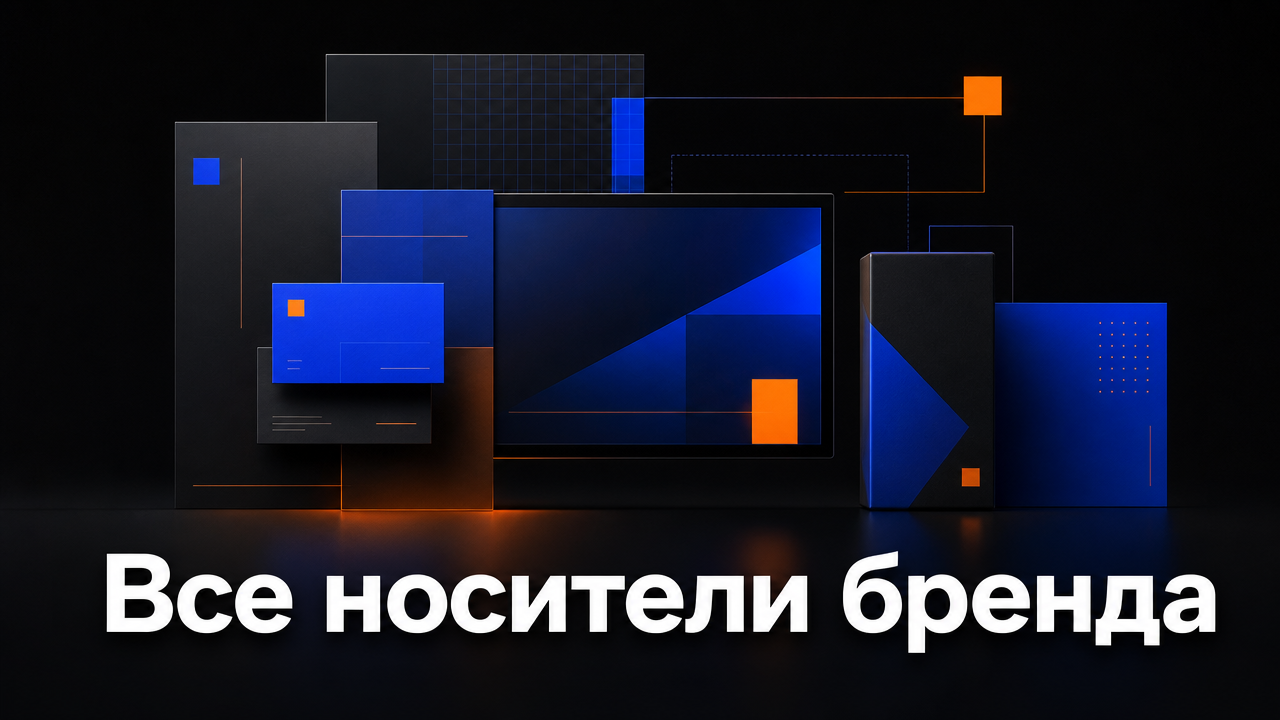
Brand identity is not just a logo and a set of colors, but a system that adapts to dozens of carriers: from business card to website, from packaging to employee uniforms. Without this system, a brand looks scattered, customers stop recognizing it, and money spent on design does not yield returns. In this article, we examine what kinds of carriers exist, how modular adaptation works, and why everything falls apart without a brandbook.
What are brand identity carriers and why this is a system
Brand identity carriers are all material and digital surfaces where a brand meets the customer: business card, website, packaging, courier uniform, advertising banner, presentation for partners. If each of these elements uses different proportions of the logo, shades of color, or fonts, the brand stops being cohesive. A customer sees one logo on the website, another — on the business card, and trust decreases: subconsciously, a person interprets inconsistencies as unprofessionalism, even if they cannot articulate it in words. A systemic approach implies that all carriers follow unified rules — a modular grid, color palette, and typography. This is an engineering foundation that allows scaling the identity to any carrier without losing recognizability, not just a 'pretty picture.' In the portfolio Gromov Branding there are projects where the number of carriers reaches 40 elements — from tickets to employee uniforms. For the airline 'Iraero,' we developed more than 30 carriers, and as a result of the project, the company's turnover increased by 1,8 billion rubles, and the margin — by 112 million rubles. Of course, the growth of these indicators is the result of work not only of design but also of the overall brand, product, and communication strategy. But that the systemic identity is embedded in this growth, and not existing separately from the business — is a fact worth keeping in mind when choosing a contractor.
Main groups of carriers
All carriers can be divided into five major groups. Each group addresses its own task and requires a specific approach to adaptation. Business carriers — business cards, stationery, envelopes, folders, presentations. They form the first impression of the company. Here, strictness and readability are important: the logo, contact details, minimalist design. A mistake at this stage is overloading the business card with unnecessary elements, and then it stops being functional. Advertising and marketing carriers — brochures, catalogs, outdoor advertising, roll-ups, banners. They must attract attention and work from a distance. Outdoor advertising requires large elements and contrasting colors, while brochures require a more detailed presentation. A modular system allows for quickly adapting the same pattern for different formats without rebuilding the layout each time. Digital carriers — website, social media, email newsletters, mobile apps, video intros. The key challenge here is adapting to different screens and resolutions. The logo must be readable on a small smartphone screen and on a wide monitor, fonts must correctly display on the web. Without a brand book with digital rules, digital carriers quickly diverge in details: a slightly different shade here, a slightly shifted logo there. Packaging and products — boxes, labels, bags, merch, souvenirs. Packaging is the product's face on the shelf. For it, shelf visibility, color coding, and ease of application are important. In the project for the logistics company Swift, more than 20 carriers were developed, including driver uniforms, stickers on transport, and packaging. The company's turnover after rebranding increased by 1,9 billion rubles, margin — by 160 million rubles. Environment and navigation — signage, indicators, office or store decoration, employee uniforms.
How to adapt a corporate identity for different carriers: a modular system
A modular system is a framework that allows you to scale a logo, graphics, and patterns on any medium without losing quality. It includes a grid, proportions, rules for element placement, and protective margins. For a business card, the logo can occupy 20% of the area, for outdoor advertising — 10%, but the proportions relative to the edges remain the same. Colors also adapt to each channel: CMYK is used for printing, RGB for screens, and Pantone for fabric. Fonts sometimes have separate web versions for websites and print font families. Patterns and textures scale while preserving rhythm — the design does not "float" or become distorted when transferred from a business card to a banner 3×6 meters in size. According to the spidran methodology, a basic set of Gromov Branding media with a ready-made modular grid is assembled within 2–3 weeks. This is especially important for startups and companies that need to quickly launch to the market with an already recognizable visual identity. At the same time, all media are immediately fixed in the brandbook — so that after six months no one will ask, "What is the actual shade of blue we have?"
Errors in selecting and adapting media
The first mistake is ignoring digital media. The company orders business cards, forms, brochures, but the website and social networks remain without rules. As a result, the logo on the website is placed on a white background, while in social networks it is on a black background, with different fonts. The brand loses integrity exactly where the first contact with most clients occurs today. The second mistake is overloading. The desire to fit all identification elements onto each medium leads to visual noise. On business cards, they try to fit the logo, pattern, all contacts, and the slogan — in the end, no element works, and the eye simply doesn't know where to grasp. The third mistake is the absence of a brand book. Without a document that fixes the rules, over time the media begin to live their own lives: employees change colors themselves, add elements, and after a year the brand looks different from how it was originally intended. In the agency's practice, there was a case: a client from Gromov Branding came who had previously worked with another contractor — the logo on the website and on the packaging differed in color by approximately 15%. Redesigning the entire system from scratch cost less than trying to align the divergent versions.
How to order the development of a corporate style with a full set of media
Gromov Branding specializes in comprehensive brand style development — from strategy to brandbook with all media. Strategists, art directors, designers and producers participate in the project, with each media being designed with specific business tasks and communication channels in mind. It is worth separately mentioning the trademark registration guarantee: if Rospatent refuses registration, the agency will develop a new logo at its own expense and pay for re-registration. This removes one of the most unpleasant risks of branding from the client — when after months of work it turns out the mark cannot be protected. Timelines depend on volume: from 2–3 weeks for a basic set of media using the speedrun methodology to 4–8 weeks for a full cycle with brandbook and all media if the project is complex and includes dozens of elements. To discuss your project, call 8 800 200-84-50 or write to hello@gromovbranding.ru — specialists will provide detailed information on the process, timelines and cost, and show examples from the portfolio of brand style development.
How many carriers should be in the basic set? The minimum set includes 10–15 carriers: business card, blank, envelope, folder, presentation, website, social media profiles, email signature, packaging (if it is part of the product), and a souvenir. For most companies, this is sufficient to get started. Do social media carriers need to be developed separately? Yes, each social media platform requires its own formats: avatar, cover, post templates, stories. They are adapted to the specific platform requirements but maintain a unified brand style. Does the number of carriers affect the cost of development? Yes, the cost depends on the volume of work. However, the modular system allows scaling carriers without proportional growth in design costs — once the grid is set up, it works for all formats with almost no further adjustments. Can additional carriers be added later, after launch? Yes, if there is a brandbook with rules — any new carrier is developed based on established principles. This takes less time and costs less than creating a system from scratch. What is included in the brandbook for carriers? The brandbook includes all rules for using the identity: modular grid, color codes, fonts, patterns, examples of layout for each type of carrier, protective margins, and prohibited usage variants. This is a document that ensures brand consistency for years to come — and it is exactly what new employees refer to when they ask whether they can repaint the logo in the company's signature green for the sales department.
MegaFon, BMW, VTB and more 240+ companies. See how it looks in the showcase reel:


Through interviews, surveys and workshops, our branding agency identifies the true needs of the business, motivations and pain points. Based on this data, we determine the tools that will effectively solve your brand's tasks.
Our branding agency is approached to order:
Our branding agency is approached to order:
Branding agency services












