Stages of brandbook development: from collecting materials to final document
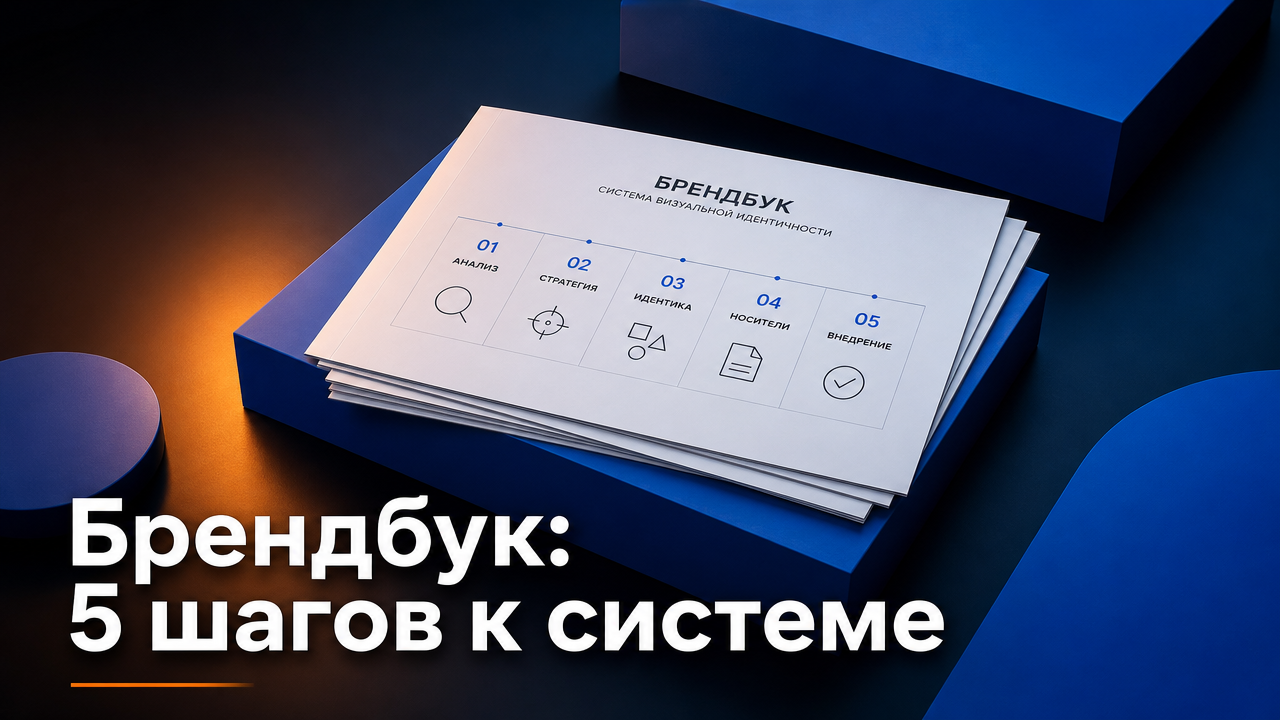
A brandbook is a document that fixes all brand elements: from strategy to logo usage rules. Its development goes through five sequential stages: research and material collection, brand platform creation, visual identity design, rule fixation, and implementation. Each stage has clear timelines and outcomes. A proper methodology transforms a brandbook from a 'pretty folder' into a working tool used by employees, contractors, and partners.
What is a brandbook and why are stages necessary
A brandbook is a set of rules describing how a brand looks, speaks, and behaves. Without a staged approach, the document becomes disorganized: important sections may be missing, and rules may contradict each other. A designer may assert one shade of blue, a marketer may use another in presentations, a contractor may use a third for signage, and half a year later the brand looks like three different companies. In the practice of agency Gromov Branding, which has implemented more than 120 projects across various industries — from food delivery to airlines and state corporations — brandbook development always starts with research and ends with implementation control. This approach ensures that the document is not just a beautiful PDF, but a working instruction that helps business grow. In the Swift case (freight transport), systematic branding accompanied a turnover growth of 1,9 billion rubles and a margin increase of 160 million rubles. For airline Iraero, these figures were 1,8 billion and 112 million rubles respectively. Of course, a brandbook alone does not drive such figures — it works in a system with strategy, product, and marketing, but without it, systematic approach is simply impossible.
Stage 1: Research and material collection
The first stage is the foundation of the entire brandbook. Specialists collect information about the company, its market, competitors, and audience. Without quality research, subsequent decisions risk becoming detached from reality. What is done at this stage: Audit of current materials: if the company already has a logo, website, packaging — their condition and alignment with strategy are analyzed. It often turns out that the old logo is not protectable or is being used in unacceptable variants. Competitor analysis: visual and semantic solutions of direct competitors and industry leaders are studied — this helps to find an unoccupied niche and avoid repeating others' moves. Customer development and in-depth interviews with key stakeholders — owners, top managers, employees, clients. In the Swift project, the team Gromov Branding conducted interviews with drivers and dispatchers to understand the real pains and values of the business. It turned out that for drivers, it's not only about delivery speed but also about the company's status, which they represent — a detail that later influenced the tone of brand communication. Market and trend analysis: industry trends are studied to ensure the brand looks modern and doesn't become outdated within a year. The result of this stage is a brief, analytical report, an association map, and a target audience portrait. Without this work, the brandbook risks becoming beautiful but useless: for example, containing colors that don't resonate with the audience or fonts that are unreadable on packaging. Timing: from 1 to 2 weeks depending on the complexity of the business and data availability.
Stage 2: Brand platform development
Brand platform — the semantic basis on which the entire visual identity is built. At this stage, positioning (the brand's place in the consumer's mind), values and mission, brand archetype (for example, 'Hero', 'Caring', 'Rebel'), and CVP — the value proposition, that is, what the client specifically receives — are formulated, as well as the tone of communication: official, friendly, or bold. Without a platform, visual solutions become random: colors are chosen 'because they like them,' not because they logically follow from the archetype and positioning. For a brand with the 'Ruler' archetype, deep purples and gold shades are appropriate, while for an 'Explorer,' natural tones and open spaces are suitable. In Gromov Branding, this stage uses a proprietary speed-ran methodology — rapid strategy development focused on implementation. It allows completion within 2–3 weeks instead of the usual 4–6 by means of a series of workshops with key company figures: a unified vision is formed immediately, which reduces the number of revisions in subsequent stages. The result is a brand platform document that serves as the foundation for the brandbook. It contains not only formulations but also examples of their application in real communication.
Stage 3: Creating visual identity
When the meanings are defined, the team moves on to visual implementation. At this stage, a logo is developed — the main version, additional versions, minimum size, protective field, and unacceptable variants of use. Meanwhile, a color palette is formed with exact values in Pantone, CMYK, RGB and HEX, typography is selected — fonts for headings, text, numbers and web version with rules for their combination, as well as a modular system and grid for creating layouts on different media. Separate patterns, icons and photostyle are also developed: studio shots or reportage, with people or without. All of this is tested on key media — business card, letterhead, envelope, website, packaging, transportation, souvenirs. Each element here is justified by strategy, not the designer's aesthetic taste. For the airline Iraero, the agency developed a dynamic identity with a pattern referencing a flight map — this visually connected the brand with its core service and made it recognizable on any media, from tickets to aircraft interiors. The result of this stage is a set of layouts on media that can be shown to management and approved before being fixed in the brandbook. It is important to check how the identity looks in real conditions: on screen, in print, on large format. Timing: 2–4 weeks depending on the number of media and complexity of the visual system.
Stage 4: Fixing the rules in the brandbook
At this stage, all developed elements are formatted into a structured document. A standard brandbook includes several mandatory blocks. It is important to distinguish between a brandbook and a style guide. A brandbook includes strategy and philosophy — it explains the 'why' behind each rule. A style guide is only a technical instruction, often without explanations. For small businesses, a style guide is usually sufficient, while medium and large enterprises need a full-fledged brandbook — especially if several contractors work with the brand simultaneously. A brandbook should be understandable not only to a designer but also to a manager, contractor, and printer. In the project for Polar Airlines, the document specified rules for logo usage on the fuselage, taking into account the technical limitations of aircraft painting — including the minimum size and acceptable angles of application. Such detail eliminates errors during production. The result is a ready document in PDF format, often with interactive navigation through sections. A good brandbook is not a picture album, but a reference manual in which the needed rule can be found in just a few clicks. Timing: 1–2 weeks for layout and approval.
Section What It Contains: Introduction, Brand Philosophy, Mission, Values — briefly, so that a new employee immediately understands the essence, Logo — all versions, protective field, minimum size, prohibited variants (distortion, overlay on background, color change), Colors — exact values in different color models, combinations, background colors, gradient rules, Fonts — names, styles, point sizes, examples of headline and body text layout, Modular Grid — principles of layout construction, margins, proportions, Media — business cards, stationery, presentations, website, social networks, packaging, souvenirs, transportation, signage, Tone of Communication — examples of text, prohibited formulations, rules for addressing the audience
Stage 5: Implementation and Control
The most important step that is often skipped. A brand guide must be implemented into the company's daily operations, not simply sent via email to the director. For this purpose, the document is handed over to all key employees — marketing, design, procurement department, PR, production. Training is conducted, preferably in the format of a workshop, where rules are demonstrated on real examples of how to apply them in practice. Then, based on the brand guide, ready-made templates are created — presentations, forms, social media templates — so that employees don't have to constantly refer to the document for simple tasks. A person responsible for monitoring compliance is appointed, usually a brand manager or marketer. An audit is conducted after 3–6 months: all media are checked for compliance with the rules, typical errors are identified. A brand guide is a living document. When launching new products, channels or media, it is supplemented. If a company enters marketplaces, rules for product card formatting are added to the brand guide. Without the implementation stage, even the most developed brand guide remains a beautiful PDF file gathering dust on the shelf — while in practice, the logo is used in a distorted form, colors are taken 'by eye', and fonts are replaced with standard system fonts.
What is included in a brandbook? A section on the brand — mission, values, positioning, rules for using the logo, colors, fonts, modular grid, examples of media, tone of communication. In the extended version, sections on packaging, merchandising, and digital may also be included. How long does development take? On average, 4–8 weeks. When using the speed-run methodology, the strategic part is shortened to 2–3 weeks, and the total time is reduced to 4–5 weeks. The exact timelines depend on the volume of media and the speed of approval from the client. How much does brandbook development cost? The cost depends on the volume of work, number of media, need for trademark registration, and depth of strategic development. A precise estimate can be obtained after a briefing — specialists from Gromov Branding prepare it free of charge and provide a detailed breakdown of the work scope. Can a brandbook be developed independently? Technically, yes — one can compile a PDF with the logo and colors. However, without a professional strategic foundation, there is a high risk of obtaining a set of rules that do not work toward business goals: colors may be unreadable on packaging, and the logo may not pass trademark registration. What is the difference between a brandbook and a guideline? A brandbook includes strategy and philosophy, while a guideline contains only technical rules. A brandbook answers the question 'why,' while a guideline answers the question 'how.' For internal use, a guideline is often sufficient, but for external contractors and partners, a brandbook is needed. Is a brandbook necessary for small businesses? If the business plans to scale, enter marketplaces, hire contractors or franchisees — then yes. For micro-businesses with a single owner, a guideline is usually sufficient.
MegaFon, BMW, VTB and more 240+ companies. See how it looks in the showcase reel:


Through interviews, surveys and workshops, our branding agency identifies the true needs of the business, motivations and pain points. Based on this data, we determine the tools that will effectively solve your brand's tasks.
Our branding agency is approached to order:
Our branding agency is approached to order:
Branding agency services












