Brand archetypes: complete guide with examples of Russian and global companies
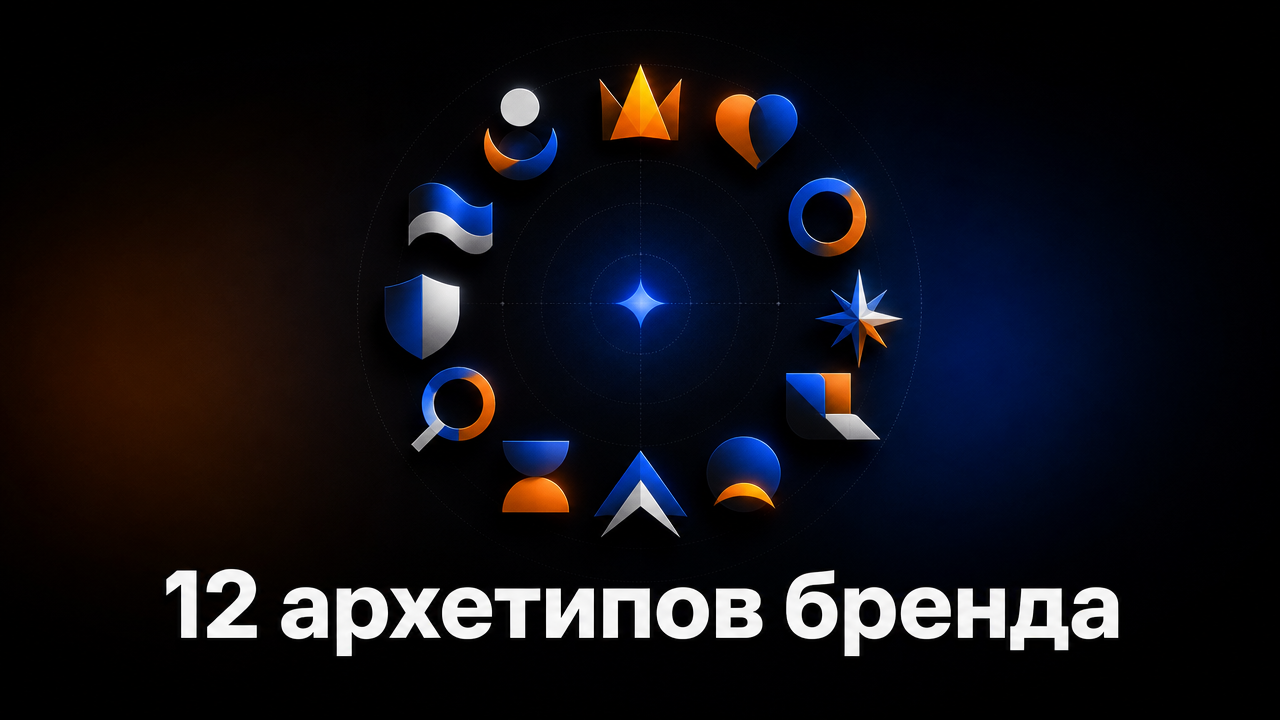
Brand archetypes are universal images from the collective unconscious that help companies occupy a clear emotional niche in consumers' minds. In this article, we'll explore 12 archetypes based on the model by Margaret Mark and Carol Pearson, illustrate them with examples of global and Russian brands, provide a brand archetype selection algorithm, and explain how it defines the brand's visual language and communication. This material is useful for business owners, marketers, and anyone involved in positioning.
What are brand archetypes and why are they needed
Archetypes are basic behavioral models and images described by the Swiss psychologist Carl Jung. He studied myths and legends of different cultures and noticed: despite differences in languages and epochs, the same character types repeat in them — warrior, sage, fool, lover. In 2001 year, marketers Margaret Mark and Carol Pearson adapted this theory for branding in the book "The Hero and the Rebel", proposing 12 archetypes as a positioning tool. The essence is as follows: a person subconsciously recognizes a familiar character type and transfers to the brand expectations that are already formed by culture. If a company speaks to its audience in the language of the Hero or the Rebel, it does not need to explain this for a long time — the image is read almost instantly. Why does a brand need an archetype? It solves three tasks: Helps to stand out. When competitors unanimously claim "quality and reliability", the archetype sets a clear emotional position that is hard to copy without losing meaning. Simplifies communication. Instead of long explanations of the company's philosophy, it is enough to have one recognizable image. Strengthens loyalty. People tend to choose brands whose character coincides with their own values — this confirms the basic logic of consumer psychology, on which the entire archetype theory is built. Nike has held the Hero archetype for decades — "overcome yourself, become better". Dove chose the Caregiver — "you are beautiful as you are". Both brands have not changed their position for years, and the audience perceives them as consistent and sincere (unlike companies that changed their communication style three times in five years). In the branding agency Gromov Branding, archetype development is an obligatory step in the positioning strategy.
12 brand archetypes with examples
The classical model divides archetypes into four groups based on fundamental motivations: stability, belonging, risk, and mastery. Let's examine each archetype with examples of global and Russian brands. [H3] 1. Hero Motto: "Overcome obstacles, become better." Global example: Nike — inspires athletic achievements. Russian example: Sber — an ambitious leader who constantly sets new goals and transforms. [H3] 2. Rebel Motto: "Break the rules, change the norms." Global example: Harley-Davidson — a symbol of freedom and independence. Russian example: Dodo Pizza — disrupted stereotypes about the pizza business by making processes transparent and tech-driven. [H3] 3. Magician Motto: "Turn dreams into reality." Global example: Disney — creates a sense of magic and wonder. Russian example: Yandex — turns complex technologies into simple and useful services. [H3] 4. Ruler Motto: "Control, manage, create order." Global example: Mercedes-Benz — status, reliability, power. Russian example: Gazprom — a symbol of stability and national scale. [H3] 5. Caregiver Motto: "Care for others, share warmth." Global example: Johnson & Johnson — care for the customer and their family. Russian example: Magnit — affordable products for the whole family, closeness to the buyer. [H3] 6. Creator Motto: "Create something new, express yourself." Global example: Lego — endless possibilities for building and imagination. Russian example: Bosco — elegant style and attention to detail. [H3] 7. Explorer Motto: "Explore, discover, be free." Global example: The North Face — gear for travel and adventures. Russian example: KupiBilet — a flight search service that helps discover the world. [H3] 8.
How to choose an archetype for your brand
Choosing an archetype is a strategic decision, not a creative experiment. The mistake here is expensive: it is harder and more costly to restructure the visual system and communication at a later stage than to thoughtfully plan the positioning from the start. Here is a working algorithm of three steps. Step 1. Define the company's values. Why do you exist? What benefit do you bring? What principles are you unwilling to abandon even under market pressure? Honest answers to these questions immediately eliminate half of the archetypes — for example, a company with strict product discipline is unlikely to suit the Jester archetype. Step 2. Study the target audience. Who are you speaking to? What values do your clients hold? Which image will inspire trust rather than rejection in them? If the audience is young entrepreneurs, they will resonate more with the Rebel or the Seeker rather than the ruler with his language of control and hierarchy. Step 3. Analyze competitors. Which archetypes are already occupied in the niche? If everyone around exploits the Hero archetype, it is worth looking at an unoccupied niche — for example, the Nurturer or the Sage. Thus, the brand becomes more noticeable simply because it does not repeat another's tone. It is additionally important to answer three control questions: What emotion do you want to evoke in the client at the moment of contact with the brand? Who is your ideal buyer and what is important to them? What differentiates you from competitors not in words in a presentation, but in real business processes? If the answers turn out vague or contradict each other — this is a signal that the decision should be made together with experts, not intuitively. In Gromov Branding, strategic sessions with the brand team and market analysis are conducted to determine an archetype that is organic specifically for a given business, not taken from a general list of 'what suits everyone'.
How does an archetype influence design and communication?
An archetype is not an abstract idea for presentation, but a working tool that directly determines the brand's visual language: colors, fonts, shapes, style of photography, and textual intonation. When an archetype is chosen, all identity elements conform to one logic. The logo, packaging, website, advertising — everything conveys the same character, rather than working at cross-purposes, as often happens when design and copy are created by different contractors without a unified strategy. Gromov Branding practices this systemic approach: from positioning strategy to a complete brand book, where every medium works toward a single image.
ArchetypeVisual TraitsCommunication ToneHeroDynamic lines, contrasting colors (red, black, white)Active verbs, short slogansCaringPastel tones, rounded shapes, soft fontsWarm, supportive toneRebelNon-standard fonts, asymmetry, dark shadesProvocative, challenging slogansWiseClassic fonts, blue and greenCalm, informative delivery
What is a brand archetype in simple words? A stable image that evokes certain associations in people — almost like a character from a book or movie, except this character is a company. How many archetypes exist? In the classic Mark and Pearson model — 12, but extended versions with subtypes also appear. For most businesses, the basic set is sufficient. Can you use multiple archetypes? It's better to choose one main one — that way it's easier to maintain a consistent tone. Two or more archetypes blur the image and confuse the audience. An additional archetype is acceptable, but with clear zone division: for example, the main one is Hero, and the additional one is Sage for educational brand content. Is an archetype needed for small business? Yes. Even a small company benefits from an archetype to stand out among dozens of similar competitors and faster embed in the customer's memory — here, the branding budget is not the main thing, the key is the accuracy of the choice. How to check if the archetype is chosen correctly? Ask customers directly: what emotions does your brand evoke, what does it associate with? Does this match the image you originally intended? If not — the strategy should be adjusted, without waiting for the divergence to become noticeable in sales. Can an archetype change over time? It can, but only as part of a conscious business evolution — for example, when entering a new market. A sudden change of archetype without a clear reason is perceived by the audience as a loss of identity, not as development. If you need to accurately define a brand archetype and build a visual system around it that works for recognition and sales, contact Gromov Branding.
MegaFon, BMW, VTB and more 240+ companies. See how it looks in the showcase reel:


Through interviews, surveys and workshops, our branding agency identifies the true needs of the business, motivations and pain points. Based on this data, we determine the tools that will effectively solve your brand's tasks.
Our branding agency is approached to order:
Our branding agency is approached to order:
Branding agency services












